
Best Battery Maintainers for Winter Car Storage
Choose a winter battery maintainer by battery chemistry, garage temperature and the vehicle’s charging instructions. Use our compatibility checklist before comparing NOCO and CTEK.
Research-based buying advice. Manufacturer documentation checked on 17 November 2026. This is not a hands-on review; the guide explains our recommendations and their limits.
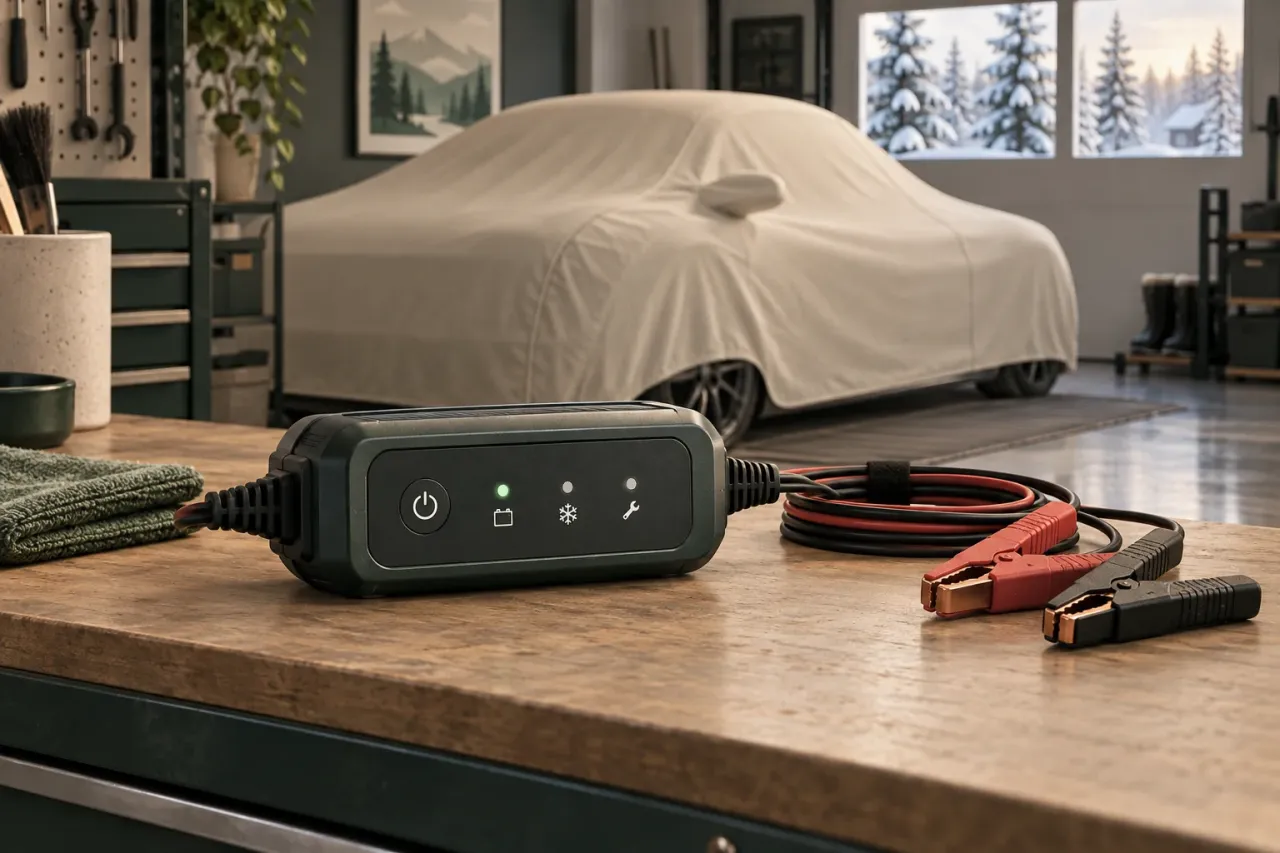
The shortlist at a glance
Compare the intended use and documented differences, then open a product for the full research.
| Product | Consider it for | Key details | Keep in mind |
|---|---|---|---|
| NOCO GENIUS5 |
Multiple supported modes Consider when you can verify the correct mode for each battery. |
|
|
| CTEK MXS 5.0 NA |
Lead-acid storage setup Consider for a compatible 12 V lead-acid vehicle battery. |
|
|
Where to buy
Confirm price and delivery at checkout| Product | Retailer | Visit retailer |
|---|---|---|
| NOCO GENIUS5 | Amazon.ca | Check Price |
| CTEK MXS 5.0 NA | Amazon.ca | Check Price |
Prices and availability can change. Confirm the final price, shipping and taxes at the retailer.
We compared the NOCO GENIUS5 and CTEK MXS 5.0 NA using manufacturer specifications and operating instructions, checked on 17 November 2026. This is a focused compatibility shortlist, not an exhaustive market ranking. We have not tested charging speed, battery recovery or winter reliability. Prices, user ratings and affiliate commissions did not determine the selections.
Start with the battery, then choose the maintainer
Our starting point: for a stored car with an ordinary 12 V lead-acid battery, compare the NOCO GENIUS5 and CTEK MXS 5.0 NA only after checking the battery label and vehicle manual. If you have a lithium replacement battery, the chemistry and battery maker's charging instructions become the deciding factors. A higher current rating alone does not make a maintainer a better fit.
This shortlist covers two approaches to a storage job. It does not establish which charger lasts longest or charges fastest in a Canadian garage: we have not measured either. Use the choices below to rule out unsuitable equipment before following a retailer link.
- A conventional or AGM car battery in storage
- Start with a charger whose documented mode matches the battery. Compare the connection arrangement and capacity limits next. Both shortlisted models warrant a closer look for compatible lead-acid batteries.
- A supported 6 V battery or a supported 12 V lithium battery
- The NOCO GENIUS5 has a broader selection of battery modes. Its lithium mode is for compatible batteries with a battery management system. Confirm the exact battery rather than treating “lithium” as a universal match.
- A 12 V lead-acid battery and a North American outlet
- The CTEK MXS 5.0 NA, model 40-206, is a candidate. CTEK lists 4.3 A output for this regional model, despite the “5.0” name. It is not a lithium charger.
- No dependable outlet where the car is stored
- Resolve the storage and charging arrangement before buying either mains-powered model. A portable jump starter serves a different purpose; see jump starter versus battery maintainer.
Mode and regional-model details: NOCO GENIUS5 instructions and CTEK MXS 5.0 NA specifications.
Complete this compatibility check before ordering
- Read the battery label. Record its voltage, chemistry and amp-hour capacity if stated. Do not infer chemistry from the vehicle's badge or the age of the battery.
- Find the vehicle's charging instructions. Check whether it specifies charging posts, a ground connection, battery-monitoring requirements or restrictions on charging in the vehicle. This guide is not a substitute for that connection procedure.
- Match the exact charger version. Check the input voltage, plug, supported battery range and selected operating mode. Similar names can describe different regional products.
- Plan access. Measure the route from the outlet to the approved connection points. Decide whether clamps or a manufacturer-approved permanent lead suit the car and storage space.
- Check the storage environment. Compare the actual garage conditions with both manufacturers' instructions. A weather-resistance label alone does not answer whether the battery can be charged safely at that temperature.
A useful purchase note is: “My battery is ___ V, ___ chemistry and ___ Ah; the vehicle permits charging at ___; the cable route is ___.” If a blank cannot be filled, clarify it before choosing a model.
What matters during a Canadian winter
A garage that stays above freezing and a detached garage exposed to prolonged cold are different use cases. Check battery condition and the permitted charging environment before starting. Never attempt to charge a frozen, leaking or damaged battery; follow the battery and charger instructions for inspection and safe handling.
Temperature compensation is not permission to charge every battery in freezing conditions. Lithium batteries in particular have model-specific charging limits. Verify those limits with the battery manufacturer even when the charger offers a lithium setting.
The CTEK North American manual and product page checked for this guide list +5°C to +50°C for ambient operation. That makes an unheated garage below +5°C a reason to stop and confirm suitability with CTEK for your exact unit, rather than assume this model covers every Canadian winter storage location.
Safety and operating guidance: CTEK North American manual and NOCO mode instructions.
Compare the whole setup, not just the box
Include any approved connection lead, cable protection and suitable power access in your comparison. Consider whether you can see the charger's status indicator without moving the car, and whether you can inspect the setup during storage. Follow the manual's instructions about ventilation, placement and cable routing; avoid pinching leads under a bonnet or garage door.
A smaller-current charger may be enough for an appropriate maintenance job, while replenishing a depleted battery is a separate requirement. If you are comparing NOCO models, our GENIUS2 versus GENIUS5 comparison explains the choice. We do not estimate charge times from the headline current rating alone.
Questions before winter storage
Can I leave a maintainer connected for the whole winter?
Only when the exact charger, selected mode, battery and vehicle instructions permit long-term maintenance. Check that the unit has reached its intended maintenance stage and inspect it as instructed. “Automatic” does not remove the need to check the battery and connections.
Should I use repair or reconditioning mode every time?
No. Treat those as separate procedures with their own restrictions, not ordinary maintenance settings. Check both the vehicle and charger instructions before selecting them, especially with the battery still connected to vehicle electronics.
Will a maintainer fix a battery that repeatedly goes flat?
Do not assume so. A weak battery, an electrical fault or a storage arrangement that keeps equipment running may need attention first. For the rest of the storage plan, read how to store a performance car for winter.
Sources and how to use this shortlist
Manufacturer documentation checked on 17 November 2026. Recommendations above are our interpretation of compatibility and storage needs. We have not tested charging speed, battery recovery or winter reliability. Confirm the current manual and exact Canadian retailer variant before purchase.