
NOCO GENIUS2 vs GENIUS5: Maintenance or Regular Recharging?
Compare retailer linksChoose around battery compatibility, capacity and the time available between uses. More output is useful only when the charging task calls for it.
Research-based buying advice. Product sources checked 2026-10-28. This is not a hands-on review. Recommendations are our interpretation of the documented features and the use cases discussed below.

Battery Chargers
NOCO GENIUS2
A 2 A mains-powered charger and maintainer for buyers whose battery compatibility and charging schedule matter more than maximum output.
Explore the details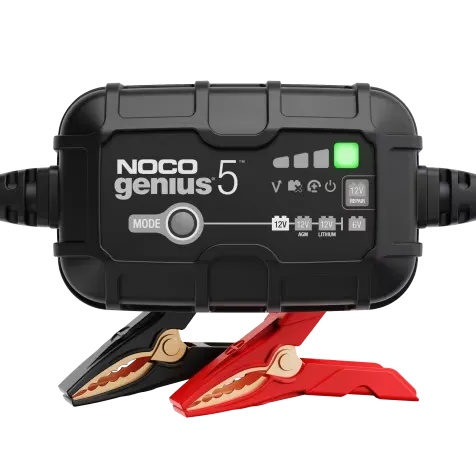
Battery Chargers
NOCO GENIUS5
A selectable-mode charger and maintainer to evaluate against the exact battery fitted to your vehicle.
Explore the detailsOn smaller screens, swipe the table to compare every product.
| Specification | NOCO GENIUS2 | NOCO GENIUS5 |
|---|---|---|
| Battery support | 6/12 V lead-acid; supported 12 V lithium mode | 6/12 V lead-acid; supported 12 V lithium mode |
| Charging current | 2 A | 5 A |
Where to buy
Confirm price and delivery at checkout| Product | Retailer | Visit retailer |
|---|---|---|
| NOCO GENIUS2 | Amazon.ca | Check Price |
| NOCO GENIUS5 | Amazon.ca | Check Price |
Prices and availability can change. Confirm the final price, shipping and taxes at the retailer.
The decision in a minute
Start with the battery label and the vehicle’s charging instructions. If both chargers support the required mode, ask whether you mostly maintain a charged battery or replenish a discharged one. The smaller unit is worth considering for a dedicated maintenance routine. The larger unit deserves a closer look when you regularly need to restore charge within a limited window. Neither is a portable jump starter.
Compare the charging ratings correctly
NOCO rates the GENIUS2 at 2 A with a charging capacity up to 40 Ah, and the GENIUS5 at 5 A with a charging capacity up to 120 Ah. The company lists maintenance separately from those charging ranges. A battery being eligible for maintenance does not mean a deeply discharged example will recharge promptly. Match the intended job to the charging specification rather than borrowing the more permissive maintenance wording.
Why 5 A does not promise an exact finish time
A higher current rating creates more potential charging capacity, but dividing battery capacity by the headline amperage does not give a dependable completion time. Starting charge, battery condition and the charge-control stages matter. If a tight turnaround is essential, look for the manufacturer’s guidance for your battery and allow time to check the result. We have not timed either charger.
Two everyday buying scenarios
For a compatible battery in a vehicle parked for weeks, write down where the charger will live and whether it will stay assigned to that vehicle. For a household sharing one charger, list the batteries and the available charging windows instead. Those two shopping lists can lead to different choices even when both households own the same car.
Compatibility comes before convenience
Do not choose a mode from the vehicle badge or battery case colour. Read the chemistry, voltage and battery instructions, including any lithium charging restrictions. The published operating range for both chargers is -20°C to 40°C; that does not override the battery’s own limits. A frozen or damaged battery needs assessment, not an experimental charging mode.
What would change our choice
Choose the GENIUS2 only when its charging and maintenance scope covers the job. Move toward the GENIUS5 when the documented capacity and higher output address a real requirement. If there is no suitable mains outlet, neither solves the location problem. Compare current seller, warranty and delivery terms before purchase; we have not assigned a universal winner.
About the illustration
The cover is an AI-generated editorial illustration of the topic. It does not depict the exact products and is not evidence of hands-on testing.